Deflection Control Strategies in Light Gauge Steel Floors
A practical guide for design engineers, project managers, and construction professionals navigating the challenges of floor performance in light gauge steel systems.
Introduction: Why Deflection Control Matters
When it comes to light gauge steel (LGS) floor systems, deflection is one of the most critical performance factors that engineers and project teams must address early in the design process. Unlike traditional concrete slabs, LGS floors rely on thin cold-formed steel members that are inherently flexible—and that flexibility, if not carefully managed, can translate into uncomfortable bouncing, cracking of finishes, and long-term serviceability problems.
Deflection control isn’t just about meeting code requirements. It’s about delivering floors that feel solid underfoot, protect architectural finishes, and stand the test of time. Whether you’re designing a mid-rise residential building, a commercial fit-out, or a modular construction project, understanding how to control deflection in LGS floors is essential to delivering a successful outcome. This guide walks you through the key strategies, practical considerations, and engineering principles that should shape every LGS floor design.
Understanding Deflection in Light Gauge Steel Systems
What Is Deflection?
Deflection refers to the displacement of a structural member under applied load. In floor systems, it manifests as visible or perceptible sag, bounce, or vibration — conditions that can compromise both structural integrity and occupant comfort.
Two Types to Watch
Live Load Deflection (L/360)
Caused by occupant activity and movable loads. Typically limited to span/360 under live loads per most building codes.
Total Load Deflection (L/240)
Accounts for both live and dead loads. The combined limit is typically span/240, ensuring long-term floor flatness and finish protection.
LGS joists are particularly susceptible because their high strength-to-weight ratio allows efficient load carrying while still exhibiting greater elastic deflection than heavier structural alternatives. Recognizing this early enables design teams to select the right mitigation strategies from the outset.
Key Factors That Influence Floor Deflection
Joist Span Length
Longer spans amplify deflection exponentially. Doubling the span increases deflection by a factor of eight. Reducing span lengths through strategic bearing point placement is one of the most effective interventions.
Loading Conditions
Both the magnitude and distribution of loads affect deflection behavior. Point loads from partitions, mechanical equipment, and concentrated fixtures require careful analysis beyond simple uniform load assumptions.
Member Depth & Section Properties
Deeper joists have a significantly higher moment of inertia, directly reducing deflection. Selecting a deeper LGS section is often the most straightforward way to improve stiffness without increasing the member count.
Composite Action & Connections
The degree of composite interaction between the steel joist and the floor deck or concrete topping significantly influences effective stiffness. Proper fastening and shear transfer can increase system stiffness substantially.
Strategy 1 — Optimizing Joist Selection and Spacing
The first line of defense against excessive deflection is smart joist selection. Choosing the right combination of joist depth, steel gauge, and spacing is foundational to any LGS floor design.
Increase Joist Depth
Moving from a 6" to an 8" or 10" joist section can dramatically reduce deflection. Deeper sections provide a larger moment of inertia (I-value), which is the primary geometric property governing stiffness.
Reduce Joist Spacing
Tightening joist spacing from 24" o.c. to 16" o.c. reduces the tributary load per member and lowers individual joist deflection. This is particularly effective in areas with higher concentrated loads or longer spans.
Increase Steel Gauge
Using heavier gauge steel (e.g., 12 gauge vs. 16 gauge) increases cross-sectional area and moment of inertia, improving stiffness. Balance this with material cost considerations.
Reinforced / Built-Up Sections
In high-load areas, built-up sections such as back-to-back or box joists provide significantly enhanced stiffness without requiring specialty members.
Strategy 2 — Bridging and Blocking Systems
The Role of Lateral Bracing
Bridging and blocking are critical components of LGS floor performance that are sometimes underestimated at the design stage. Their primary function is to prevent lateral buckling of the joist web and to distribute loads more evenly across the floor system.
When joists are properly braced, the entire floor system begins to act more as a unit rather than as individual members — improving both deflection performance and vibration resistance.
Types of Bridging
Solid Blocking
Short sections of joist material installed perpendicular between joists. Highly effective for load distribution and restraint against rotation.
Strap Bridging
Flat steel straps installed diagonally or horizontally. Economical and fast to install, particularly effective in mid-span bracing applications.
X-Bridging
Cross-bracing installed between joists at regular intervals. Provides bidirectional restraint and is particularly effective in longer span applications.
Industry practice typically requires bridging at mid-span for joists up to 12 ft, and at third-points for longer spans. Always verify against the applicable standard — AISI S100 or local code requirements.
Strategy 3 — Composite Deck and Concrete Topping
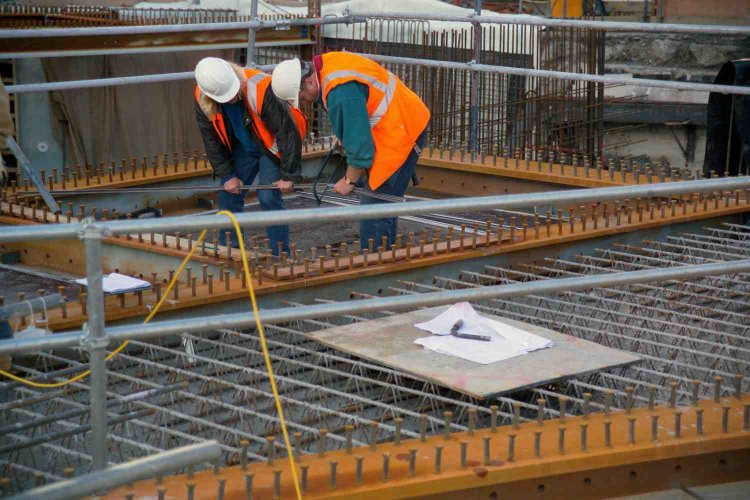
One of the most impactful deflection control strategies in LGS floor design is the use of a composite floor deck system with a concrete topping. When properly designed and constructed, composite action dramatically increases the effective stiffness of the floor assembly.
Steel Deck Selection
Choose a corrugated or ribbed steel deck with appropriate profile depth. The deck acts as permanent formwork and contributes to the composite section's stiffness.
Concrete Topping Thickness
A concrete topping of 2.5" to 3.5" above the deck ribs significantly increases the composite section's moment of inertia, often by 200–400% compared to steel alone.
Shear Connection
Positive shear transfer between the deck and the LGS joist — through puddle welds, screws, or shear studs — is essential to achieving full or partial composite action.
Strategy 4 — Pre-Cambering and Mid-Span Supports
Pre-Cambering LGS Joists
Pre-cambering — intentionally introducing a slight upward bow into a joist before loading — is a well-established technique in steel construction that is increasingly being applied to LGS systems. When the floor is loaded, the camber counteracts the downward deflection, resulting in a flatter final floor profile.
For LGS members, camber is typically introduced during fabrication and is most effective for longer spans where dead load deflection is a dominant concern. The amount of camber is calculated based on anticipated dead load deflection, usually set at 75–100% of the predicted dead load deflection.
Mid-Span Bearing Supports
Where architectural layouts permit, introducing mid-span bearing — such as interior walls, beams, or posts — is one of the most direct ways to reduce effective span length and control deflection.
Reducing the effective span by half reduces deflection by a factor of 16 (since deflection varies as the fourth power of span). Even partial bearing support can yield significant performance improvements.
Key Coordination Points
Pre-cambering is most cost-effective when specified early in the design and coordinated with the fabricator during shop drawing production.
- Structural continuity through bearing conditions
- Load path verification to foundation
- Coordination with mechanical, plumbing, and electrical routing
Strategy 5 — Vibration Control in LGS Floors
Deflection and vibration are closely related but distinct performance criteria. A floor can meet code-prescribed deflection limits while still feeling uncomfortably bouncy to occupants — a phenomenon driven by dynamic response rather than static sag.
Vibration control is therefore a separate but equally important design consideration, requiring targeted strategies that address natural frequency, damping, and system stiffness.
Natural Frequency Targeting
The natural frequency of a floor system should exceed 8 Hz for most residential and office applications. LGS floors with long spans and lightweight construction are particularly susceptible to low frequencies that coincide with walking excitation (1.5–2.5 Hz).
Floor Mass Optimization
Increasing the effective mass of the floor system — through concrete toppings or dense overlay systems — raises the natural frequency threshold and reduces sensitivity to human-induced vibration.
Damping Mechanisms
Increasing system damping through finishes, non-structural elements, and composite action reduces vibration amplitude. Concrete toppings are particularly effective damping contributors in LGS systems.
Joist Stiffness Enhancement
Higher stiffness directly increases natural frequency. Strategies such as deeper joists, closer spacing, and composite action improve both static deflection control and vibration performance.
The Role of BIM and Structural Detailing in Deflection Control
Effective deflection control doesn't happen by accident — it's the result of careful coordination across design, detailing, and construction phases. This is where Building Information Modeling (BIM) and precise structural detailing play an indispensable role.
BIM-Driven Design Coordination
- Early detection of conflicts between structural members and MEP systems
- Accurate span measurement and load path visualization
- Real-time section property updates when member sizes change
- Integration with structural analysis software for deflection verification
Structural Detailing Best Practices
- Clear documentation of joist depths, gauges, and spacing on shop drawings
- Explicit bridging and blocking schedules at mid-span and third-point locations
- Coordination of composite deck layout, fastener patterns, and topping thickness
- Pre-camber callouts reviewed and confirmed with the fabricator before production
At Consac, our integrated approach to structural engineering and BIM detailing ensures that deflection control strategies are embedded into the design from day one — eliminating costly surprises during construction and delivering floor systems that perform exactly as designed.
Code Compliance and Industry Standards
AISI S100
North American Specification for the Design of Cold-Formed Steel Structural Members — the primary standard governing LGS member design, including deflection limits and stiffness requirements.
AISC Design Guide 11
Provides comprehensive guidance on floor vibration design for steel-framed structures, including frequency targets and acceptability criteria for different occupancy types.
IBC / IRC
International Building Code and Residential Code set deflection limits for floor members — typically L/360 for live loads and L/240 for total loads — serving as minimum performance benchmarks.
SDI Standards
Steel Deck Institute standards govern the design and installation of composite deck systems, including shear connection requirements critical to achieving composite action in LGS floors.
Always verify the applicable code and edition with the local Authority Having Jurisdiction (AHJ). State and local amendments may impose more stringent deflection limits than base IBC/IRC provisions.
Practical Takeaways for Your Next LGS Floor Project
Start With Span Optimization
Before selecting member sizes, evaluate whether span lengths can be reduced through strategic placement of bearing walls, beams, or columns. Reducing span is the single most powerful deflection control tool available.
Select Deeper Joists Early
Resist the temptation to minimize member depth for cost savings at the preliminary design stage. The cost of upgrading to a deeper section early is far less than remedial measures after construction.
Design for Vibration, Not Just Static Deflection
Check natural frequency alongside static deflection limits. A floor that meets L/360 but has a natural frequency below 6 Hz will still generate occupant complaints in residential or office applications.
Leverage Composite Action Where Feasible
If a concrete topping is already planned for finish or fire rating purposes, ensure the design explicitly accounts for composite action. The stiffness gain is significant and often underutilized.
Coordinate Bridging in Shop Drawings
Bridging is frequently under-specified or omitted from shop drawings. Make sure bridging type, spacing, and installation method are clearly documented and reviewed before fabrication begins.
Conclusion: Building Better Floors with LGS
Light gauge steel floor systems offer exceptional versatility, speed of construction, and structural efficiency — but realizing their full potential requires deliberate attention to deflection control throughout the design and detailing process.
From joist selection and bridging to composite action and vibration analysis, every strategy contributes to a floor system that performs reliably, feels solid to occupants, and protects the long-term integrity of finishes and non-structural elements.
The Key is Integration
Deflection control strategies work best when coordinated across all phases — from structural design and BIM modeling to shop drawings and construction execution. When aligned, LGS floors consistently outperform heavier conventional systems.
As the construction industry continues to embrace light gauge steel for its efficiency and sustainability advantages, the engineering teams and project managers who master deflection control will be best positioned to deliver projects that stand apart in quality, comfort, and durability.
Quick Reference: Deflection Control Strategies
- Optimize joist depth and spacing
- Implement solid blocking and bridging
- Leverage composite deck and concrete topping
- Specify pre-cambering for long spans
- Introduce mid-span bearing where possible
- Design explicitly for vibration performance
- Coordinate through BIM and shop drawings
- Verify compliance with AISI S100, IBC, and SDI standards
What's Your Reaction?