Understanding Construction Loads on Steel Deck Systems
A technical deep-dive for structural engineers and detailing professionals navigating the critical load conditions that occur before a composite deck system reaches its final design state. Construction-phase loading is one of the most frequently underestimated aspects of steel deck design — and one of the most consequential.
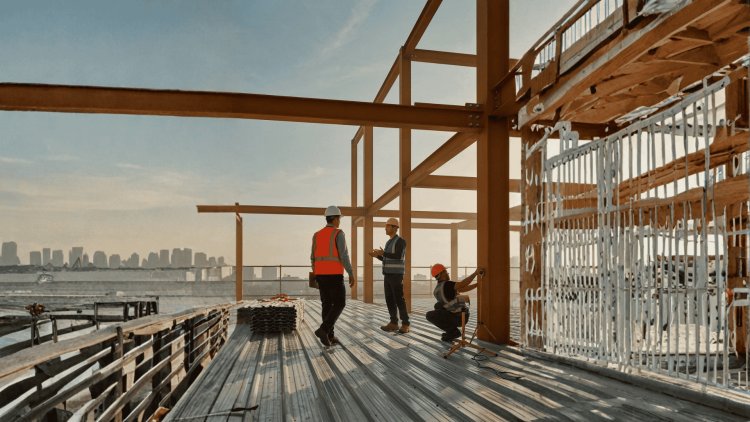
Why Construction Loads Demand Separate Analysis
The deck experiences two fundamentally different structural states: before composite action and after composite action.
Structural Behavior Changes Completely
During Construction
• Wet concrete load
• Worker & equipment loads
• No composite action
Final Condition
• Shear studs engaged
• Composite behavior
• Significantly higher stiffness
Construction Load Path
Analyze Both States
A deck that performs perfectly in its final composite condition may still fail during construction. Successful design requires separate verification of both the temporary and permanent structural states.
Construction loads on steel deck should be checked in four distinct categories, both independently and in combination, using the applicable SDI, AISC, and ASCE 37 requirements.
The practical sequence is to check wet concrete load first, then construction live load, then ponding stability, and finally stacked-material or point-load scenarios. That approach keeps the design defensible and aligned with real jobsite conditions.
The Four Primary Construction Load Categories
Steel deck performance during construction is critical. Unshored spans, side-lap fasteners, end anchorage, and camber interactions all influence safety and serviceability. Engineers must reference current SDI standards to avoid outdated assumptions.
In unshored conditions, deck acts as a one-way spanning system. Flexural stiffness depends on profile depth, gauge, and yield strength. Thinner gauges (22–20 ga) are more susceptible to mid-span deflection under wet concrete than heavier profiles. Always reference SDI DDM04 span tables for updated limits.
Side-lap fasteners (screws, button punches, welds) connect adjacent sheets and influence diaphragm behavior. Inadequate connections can cause differential deflection during pours, creating scalloping in slab soffits and cracking above ribs.
Deck sheets must be anchored at supports to resist uplift. Wind loads on partially erected decks can be severe. SDI and IBC require positive attachment with weld patterns like 36/7 puddle welds, though project-specific wind calculations may demand closer spacing.
Pre-cambered beams alter slab thickness distribution. Constant screed elevation over cambered beams increases slab depth near mid-bay, compounding deflection at critical locations. Engineers must account for this when sizing deck gauge in cambered framing schemes.
Always verify construction-phase span and load data against the current SDI DDM04 edition. Legacy tables may not reflect updated ASTM yield strength classifications or ASCE 37 load requirements, risking unsafe assumptions in deck design.
Deck Behavior Under Construction Loads: What to Watch
Unbraced Span Behavior
Side-Lap Fasteners and Diaphragm Stiffness
End Anchorage and Sheet Uplift
Slab Thickness Tolerance and Camber Interaction
Steel deck construction load analysis sits at the intersection of multiple standards. The governing document changes by check, so compliant design depends on using the right framework for each condition.
Use ASCE 37 for construction loading, DDM04 for deck span and section-property checks, and AISC Appendix 2 for ponding stability. The same project can require all three, but each governs a different part of the analysis. [web:332][web:315][web:337]
In short, construction-phase deck design is only defensible when the load case, the governing standard, and the applicable combination format are identified explicitly for every check. That is what keeps the calculation package compliant, traceable, and buildable. [web:332][web:334][web:337]
Load Combination Requirements
Practical Rule
Construction loads are a design condition in their own right, not an afterthought. For detailers and engineers producing steel deck packages, these principles should be built into every project workflow.
Pre-pour, verify gauge selection, span tables, and ponding criteria. During the pour, monitor wet concrete load and construction live load effects. After cure, confirm composite engagement and document any permanent set before closing out the package.
Designing explicitly for construction-phase loads improves structural safety, slab quality, and long-term deck performance. Packages that reflect real jobsite conditions are more reliable, more buildable, and less likely to generate RFIs or field fixes.
Key Takeaways for Detailing Professionals
Construction-Phase Sequence
What's Your Reaction?