Bridging Layouts and Seat Designs: Key Detailing Insights for Stable Structures for Joist and Deck
In structural engineering, the connection between joists and their supporting elements represents one of the most critical design considerations. These seemingly simple junctions must transfer loads safely while accommodating real-world variables like thermal movement, construction tolerances, and long-term deflection. Understanding the relationship between layout strategies and seat connection details ensures structural stability, constructability, and performance throughout a building's lifecycle

Understanding Joist Seat Connections: The Structural Foundation
|
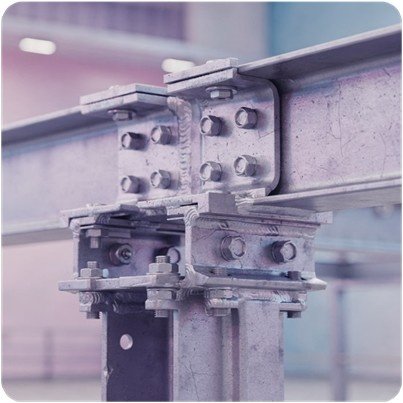
Joist seat connections serve as the critical interface where horizontal framing members meet their vertical or horizontal supports. These connections must resist gravity loads, provide lateral stability, and allow for controlled movement. The seat detail directly influences load path efficiency, construction sequencing, and overall structural behavior. Proper seat design considers bearing area, edge distance requirements, bolt spacing, and clearances for welding or field modifications. Engineers must balance theoretical load transfer with practical installation constraints, ensuring connections are both structurally sound and constructible within realistic site conditions and trade coordination requirements |
|
Layout Planning: Setting the Stage for Successful Connections
Efficient joist spacing maximizes structural performance while minimizing material costs. Standard spacing typically ranges from 2 to 8 feet on center, with closer spacing for heavy loads or long spans.
Careful coordination between joist centerlines and supporting beam or wall locations prevents eccentric loading conditions that can compromise connection integrity and increase stress concentrations.
Regular, repetitive framing patterns simplify detailing, reduce fabrication errors, and improve construction efficiency. Irregular geometries require custom connection solutions and additional engineering review. The layout phase establishes fundamental parameters that ripple through every subsequent design decision.
Critical Detailing Considerations for Seat Connections
Bearing Length Requirements
Minimum bearing length prevents edge-bearing failures and ensures adequate load distribution. Steel joists typically require 2.5–4 inches of bearing, while engineered wood products may need 1.75–3 inches depending on species and grade.
Connection Eccentricity
Offset connections introduce bending moments that must be accounted for in both the joist and support design. Minimizing eccentricity through careful detailing improves performance and reduces material requirements.
Anchorage and Fastening
Proper specification of bolts, welds, or proprietary connectors ensures adequate strength and ductility. Connection details must accommodate installation tolerances while maintaining structural integrity under all load combinations.
Thermal and Dynamic Effects
Connections must accommodate thermal expansion, construction shrinkage, and vibration without inducing overstress. Detailing provisions for movement prevent cracking, connection failure, and serviceability issues over time.
Avoiding Common Seat Connection Mistakes
Inadequate Bearing Area
Insufficient bearing surface causes local crushing, premature wear, and potential connection failure. Always verify actual bearing dimensions against code-required minimums, accounting for manufacturing tolerances and field conditions that may reduce effective contact area.
Ignoring Deflection Compatibility
Mismatched deflection characteristics between joists and supporting members can induce secondary stresses. Design connections to accommodate differential movement while maintaining load transfer capacity throughout the anticipated service life of the structure.
Poor Construction Sequencing Coordination
Connection details that look perfect on paper may prove impossible to install in the field. Collaborate with contractors early to ensure adequate access for tools, proper fit-up sequences, and realistic erection tolerances that reflect actual site conditions.
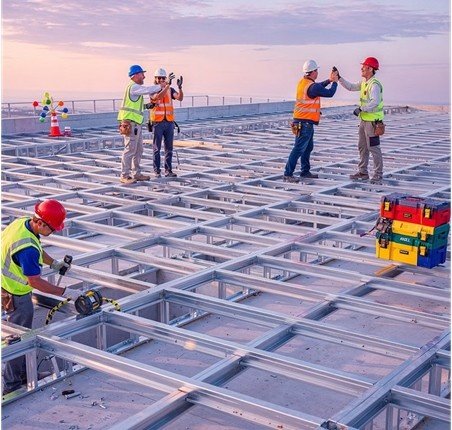
Deck Integration: Completing the Structural System
|
|
|
Modern Tools for Connection Design and Documentation
3D Modeling and BIM
Building Information Modeling enables clash detection, visualization of complex connections, and coordination across disciplines before fabrication begins. Digital models reduce errors and streamline shop drawing approval processes.
Advanced Analysis Software
Finite element analysis and specialized connection design programs evaluate complex load paths, stress concentrations, and failure modes that simplified hand calculations cannot capture accurately or efficiently.
Digital Fabrication Integration
Direct transfer of engineered connection details to automated fabrication equipment eliminates transcription errors and accelerates production schedules while maintaining precision and quality control throughout manufacturing
Building Stability Through Thoughtful Connection Design
Integrated Approach
Successful joist and deck systems require coordination between layout planning, connection detailing, and construction execution. Each decision impacts structural performance, constructability, and project economics.
Quality Documentation
Clear, comprehensive connection details prevent field confusion, reduce RFIs, and ensure installations match engineering intent. Invest time in thorough documentation to save significant costs during construction.
Continuous Improvement
Learn from each project by documenting what worked well and what challenges arose. This knowledge base improves future designs and strengthens relationships with fabricators and contractors.
The bridge between conceptual layout and detailed seat design represents where engineering theory meets construction reality. By understanding the interplay between these elements and applying proven detailing principles, structural engineers create efficient, constructible, and reliable joist and deck systems that perform as intended throughout their service life. Strategic attention to connection design ensures project success from initial concept through final installation.
What's Your Reaction?