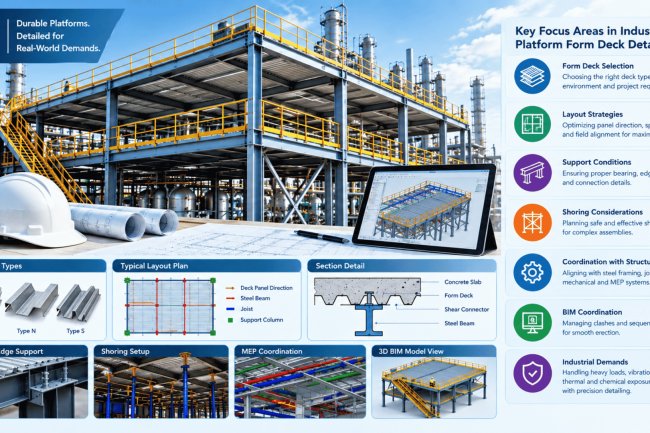
Understanding Form Deck Specifications Before You Order
Before a single purchase order is issued, procurement teams must fully decode the structural drawings and project specifications. Form deck is not a commodity item — profile depth, flute width, steel gauge, galvanization class, and load-bearing ratings all vary by application, and substituting one spec for another without engineer approval can trigger costly RFIs, delays, or structural non-compliance.
Key Specification Parameters
Profile depth: Typically 9/16", 1.5", or 3" — each driven by span requirements and concrete thickness
Steel gauge: 22, 20, 18, or 16 gauge — affects structural capacity and shipping weight
Galvanization class: G60 vs. G90 — determined by exposure conditions and project spec
Rib width & flute spacing: Must align with pour stop and edge trim selections
Load tables: Always cross-reference SDI (Steel Deck Institute) published load tables before confirming a substitute product
Common Procurement Pitfalls
One of the most frequent errors procurement coordinators make is ordering by brand name alone without verifying that the submitted product matches the specified SDI designation. Consac's deck resources detail how deck type classifications directly affect structural performance thresholds — knowledge that should inform every purchase order before it is submitted.
Similarly, galvanization mismatches are a common field rejection trigger. G60 deck delivered to a project specifying G90 will be rejected at delivery, stalling concrete pour schedules. Always confirm galvanization class against the project specifications and shop drawing submittals before order placement.
Always obtain approved shop drawings and engineer-of-record confirmation before finalizing form deck specifications for procurement. Never substitute profiles based on price alone.
Always obtain approved shop drawings and engineer-of-record confirmation before finalizing form deck specifications for procurement. Never substitute profiles based on price alone.
Lead Times, Supplier Sourcing & Schedule Alignment
Form deck lead times are not static. They fluctuate based on mill production cycles, regional distribution inventory, profile popularity, and overall market demand. In today's supply chain environment, procurement teams that plan around "standard" 3–4 week lead times are routinely caught off guard. Building a realistic procurement schedule requires understanding the full chain — from mill to fabricator to jobsite.
Custom gauges or uncommon profiles (e.g., deep-rib 3" form deck in 16ga) may carry 8–12 week mill lead times. Common profiles in 20ga and 22ga are frequently available from distributor stock at 1–3 week lead times. Always verify current availability with at least two regional distributors before locking in the project schedule.
Phased Delivery Planning
Multi-story or multi-bay projects require phased delivery scheduling tied directly to the concrete pour sequence. Procurement teams should work with the superintendent to map pour zones and sequence deliveries so deck arrives no more than 48–72 hours ahead of scheduled erection. Early delivery creates site storage problems and weather exposure risk.
Not all distributors stock the same SDI-certified product lines. Require mill certifications with each delivery and confirm that your supplier's product is listed with SDI or ICC-compliant. Coordinating joist and deck procurement from compatible suppliers reduces submittal cycle time and RFI exposure on combined packages.
Building Your Procurement Timeline
A reliable procurement timeline for form deck on a mid-size commercial project should be structured around key project milestones. Begin supplier outreach immediately after structural drawings are issued for permit — do not wait for approved shop drawings. Use the IFC (Issued for Construction) drawing set to develop a preliminary bill of materials and request budgetary lead time quotes from at least two qualified suppliers.
Week 0–2
Structural drawings issued → Begin preliminary BOM and supplier outreach
Week 2–5
Shop drawing submittal prepared → Submit to engineer of record for review
Week 5–7
Shop drawing approval received → Issue purchase order with confirmed delivery windows
Week 7–10
Phased deliveries begin per pour sequence schedule
Managing Schedule Risk
The biggest schedule risk in form deck procurement is the gap between shop drawing submittal and engineer approval. RFIs requesting profile substitutions or gauge changes can add 2–4 weeks to the approval cycle. Procurement teams can compress this risk by pre-qualifying alternate products during the bidding phase, so that if a primary product becomes unavailable, an approved alternate is already in the submittal pipeline.
Additionally, steel joist detailing coordination directly affects deck layout and bearing conditions — misalignment between joist camber data and deck panel lengths is a common source of field delays. Procurement teams should ensure joist and deck submittals are reviewed concurrently, not sequentially.
Form Deck Procurement
Quantity Takeoffs, Budget Control
& Order Accuracy
Accurate quantity takeoffs are the foundation of cost-effective form deck procurement. Overbuy drives up project costs and creates surplus material disposal challenges; underbuy triggers emergency reorders at premium pricing and stalls concrete pours. Procurement teams must build a disciplined takeoff methodology that accounts for waste, coverage area, lap conditions, and accessory items that are frequently missed on first pass.
Section 01
Takeoff Methodology
Calculate net square footage of each pour zone separately, then apply a waste factor—typically 5–8% for standard rectangular bays, up to 12% for irregular geometries with significant cutting. Account for end laps (typically 2") and side laps when calculating sheet coverage. Missing lap allowances is one of the most common causes of field shortages on deck projects.
5–8%
Waste factor for standard rectangular bays
Up to 12%
Waste factor for irregular geometries with significant cutting
2"
Typical end-lap allowance
Form deck accessories are consistently underordered. A complete procurement package should include: pour stops and edge trim (LF), deck screws or puddle welds per structural specification, closures and end closures, roof edge and parapet conditions if applicable, and any form board requirements for one-way slab conditions. Missing accessories trigger separate spot orders at retail pricing.
Item 01
Pour stops and edge trim (LF)
Item 02
Deck screws or puddle welds per structural specification
Item 03
Closures and end closures
Item 04
Roof edge and parapet conditions if applicable
Item 05
Form board requirements for one-way slab conditions
Establish unit cost benchmarks per square foot for each gauge and profile combination based on regional pricing. Track variance between budgeted and actual costs across projects to build an internal pricing database. Commodity steel pricing fluctuates significantly—procurement teams should request firm pricing valid for at least 30 days and align purchase order issuance with pricing windows. Consac’s blog library provides additional context on structural material coordination that informs budgeting decisions.
Benchmark
Unit cost per square foot for each gauge and profile combination, based on regional pricing.
Track variance
Compare budgeted and actual costs across projects to build an internal pricing database.
Pricing window
Request firm pricing valid for at least 30 days and align purchase order issuance with pricing windows.
Section 04
Order Accuracy Checklist
Before submitting a purchase order for form deck, verify the following line items are confirmed and documented:
1
SDI designation and profile depth confirmed against approved shop drawings.
2
Steel gauge verified against structural engineer specifications.
3
Galvanization class (G60 or G90) confirmed.
4
Sheet lengths match structural bay dimensions with lap allowance.
5
Accessory items (pour stops, closures, fasteners) included in PO.
6
Phased delivery windows tied to pour sequence confirmed with supplier.
7
Mill certifications required with each delivery documented in PO terms.
8
Approved alternate product on record in case of availability issue.
05
Managing Change Orders & Scope Shifts
Change orders affecting slab thickness, span conditions, or pour zone boundaries directly impact form deck quantities and specifications. Procurement teams must establish a change order trigger protocol—any structural change issued after purchase order placement should automatically generate a deck quantity review before the change is incorporated into field work.
Contingency
10–15%
Of the deck line item is standard practice for projects with complex geometries or phased scope releases.
Release condition
75%
Of shop drawing approvals complete—contingency is released only when final pour zone quantities are confirmed.
Real-time tracking
Open PO vs. installed quantities
A simple shared spreadsheet updated by the superintendent after each pour provides the data needed to manage the balance of the deck order intelligently.
Procurement principle
Accurate quantity takeoffs are the foundation of cost-effective form deck procurement.
Build a disciplined takeoff methodology that accounts for waste, coverage area, lap conditions, and accessory items that are frequently missed on first pass.
Key Takeaways & Procurement Action Plan
Effective form deck material scheduling is a discipline that combines specification literacy, supplier relationship management, timeline engineering, and rigorous quantity control. Procurement teams that build these capabilities into their standard workflow consistently deliver deck packages on time, within budget, and without the field disruptions that plague reactive purchasing cycles.
1
Start Procurement Early — Before Shop Drawing Approval
Initiate supplier outreach and preliminary BOM development immediately after IFC drawings are issued. Do not wait for shop drawing approval to begin sourcing. Use the preliminary BOM to lock in lead time windows and pre-qualify alternate products. This single practice eliminates the most common cause of deck schedule delays on commercial projects. Reference joist and deck coordination resources to align your deck procurement timeline with the broader structural package.
Validate Every Specification Parameter — Never Substitute Without Engineer Approval
Profile depth, gauge, galvanization class, and SDI designation must all be verified against approved submittals before PO issuance. Substitutions made without engineer-of-record approval create structural compliance risk and field rejection exposure. Build a specification verification checklist into your standard procurement workflow and require sign-off before orders are placed.
2
3
Sequence Deliveries to the Pour Schedule — Not to Convenience
Phased delivery tied to the concrete pour sequence protects the site from storage problems, weather exposure, and handling damage. Work with the superintendent to map pour zones 3–4 weeks in advance and build delivery windows into the purchase order terms. Communicate schedule changes to your supplier immediately — most distributors can accommodate minor window adjustments with 48–72 hours notice.
Include All Accessories in the Original PO
Pour stops, edge trim, closures, and fasteners must be included in the original purchase order — not treated as field buyouts. Spot orders for accessories carry retail pricing premiums and often arrive on different lead times than the primary deck package, creating installation bottlenecks. A complete accessory takeoff completed alongside the deck quantity takeoff is the most reliable way to avoid this common and costly mistake. Visit Consac's deck resources for additional guidance on deck accessory coordination and specification alignment.
4
Procurement excellence on form deck projects is measured not just by unit cost, but by schedule reliability, zero field rejections, and complete accessory coverage. Build your workflow around these standards and your deck packages will consistently support — rather than constrain — the project schedule.
Schedule Reliability
Zero Field Rejections
Complete Accessory Coverage
Procurement excellence on form deck projects is measured not just by unit cost, but by schedule reliability, zero field rejections, and complete accessory coverage.