Role of Augmented Reality in Light Gauge Steel Assembly
Leveraging cutting-edge Augmented Reality (AR) technology to precisely guide light gauge steel assembly, significantly improving construction accuracy, minimizing errors, and boosting overall project efficiency on the job site.
Transforming Steel Assembly with Digital Vision
The construction industry stands at a pivotal intersection of traditional craftsmanship and cutting-edge technology. As projects grow more complex and timelines tighten, the demand for precision in light gauge steel assembly has never been higher. Augmented Reality (AR) is emerging as a transformative solution, overlaying digital information onto physical environments to guide workers through assembly processes with unprecedented accuracy.
This technology bridges the gap between design intent and field execution, reducing errors, accelerating workflows, and ultimately delivering better outcomes for project stakeholders across the built environment.
Understanding Light Gauge Steel in Modern Construction
Light gauge steel framing has become increasingly popular in commercial and residential construction due to its strength-to-weight ratio, dimensional stability, and sustainability benefits. However, the precision required for proper assembly presents ongoing challenges.
Complex Geometries
Modern architectural designs often feature intricate steel configurations that are difficult to visualize from traditional 2D drawings alone.
Coordination Challenges
Multiple trade disciplines must work in harmony, requiring precise spatial understanding of where steel components intersect with MEP systems.
Quality Control
Even minor installation errors can compound throughout a project, leading to costly rework and schedule delays that impact the entire construction timeline.
How Augmented Reality Works on the Job Site
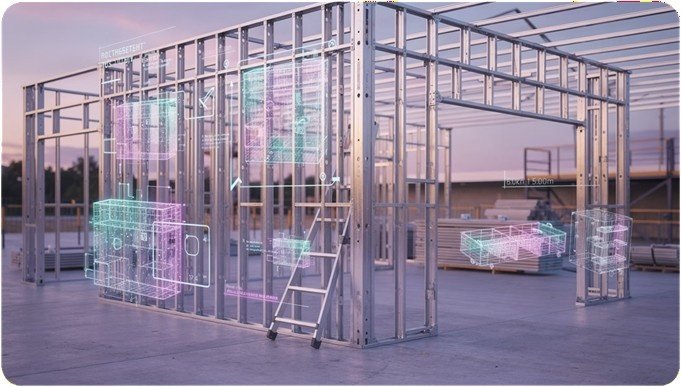
AR technology superimposes computer-generated imagery onto a user's view of the physical world, typically through specialized headsets, tablets, or smartphones. For steel assembly, this means workers can see exactly where each component should be placed, how it connects to adjacent members, and what the final assembly should look like—all while keeping their hands free to work.
The system uses BIM models as its data source, translating complex 3D information into intuitive visual guidance that even less experienced workers can follow accurately. Spatial anchors and tracking technology ensure that digital overlays remain precisely aligned with physical structures as workers move around the site.
Measurable Benefits of AR in Steel Assembly
Enhanced Accuracy
AR eliminates guesswork by showing precise placement locations, reducing measurement errors and ensuring components are installed according to design specifications from the first attempt.
Faster Training
New workers can become productive more quickly when visual instructions guide them through assembly sequences, reducing the learning curve associated with complex structural systems.
Real-Time Verification
Immediate feedback on installation accuracy allows teams to identify and correct issues before they cascade, maintaining quality standards throughout the construction process.
Reduced Rework
By catching errors early and ensuring correct initial installation, AR significantly decreases the time and material waste associated with correcting mistakes after the fact.
Practical Applications Across Project Phases
Companies like Consac are helping organizations integrate AR technology into their digital workflows, creating seamless connections between design, detailing, and field execution. The technology's versatility makes it valuable throughout multiple project stages.
Pre-Construction Planning
AR enables teams to conduct virtual walkthroughs of steel framing systems before fabrication begins, identifying potential conflicts and optimizing assembly sequences in a risk-free digital environment.
During active construction, AR becomes an indispensable field tool. Workers reference the technology to verify member sizes, confirm connection details, and ensure proper spacing—all without returning to paper drawings or making time-consuming measurements.
This real-time guidance maintains project momentum while ensuring quality standards are consistently met.
Design Visualization
Stakeholders review proposed steel configurations in context
Clash Detection
Teams identify and resolve coordination issues digitally
Sequence Planning
Optimal installation order determined before field work begins
Material Optimization
Precise quantities and specifications confirmed
Overcoming Adoption Challenges
While AR offers compelling advantages, successful implementation requires thoughtful planning and organizational commitment. Initial hardware investments and software licensing can be significant, though costs continue to decrease as the technology matures.
Perhaps more critically, teams need adequate training and support during the transition period. Workers accustomed to traditional methods may initially resist change, making change management and clear communication about benefits essential for adoption success.
Technical considerations also matter. AR systems require high-quality BIM models with accurate geometry and metadata. Site conditions—including lighting, dust, and connectivity—can affect system performance and must be addressed through proper equipment selection and installation protocols.
What's Your Reaction?