Light Gauge Steel for Industrial Warehouses
Large-span structural solutions transforming modern industrial construction through advanced engineering, rapid deployment, and unmatched design flexibility for today's demanding warehouse environments.
Why Light Gauge Steel is Revolutionizing Warehouse Construction
Industrial warehouses demand structural systems that deliver exceptional span capabilities, cost efficiency, and rapid construction timelines. Light gauge steel (LGS) has emerged as a transformative solution for large-span industrial applications, offering engineers and developers unprecedented flexibility in design and execution.
As e-commerce growth and supply chain demands accelerate warehouse development across North America, the construction industry is embracing advanced framing technologies that reduce material waste, lower transportation costs, and enable faster project delivery. Light gauge steel framing systems answer these challenges while maintaining the structural integrity required for industrial-scale operations.
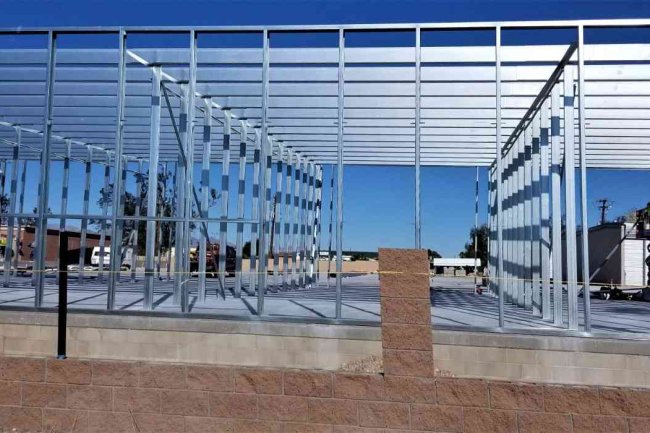
Light gauge steel refers to cold-formed steel members typically ranging from 12 to 33 mils in thickness, manufactured through a continuous roll forming process. Unlike hot-rolled structural steel, LGS members are precision-engineered to exact specifications, creating consistent, high-quality components ideal for repetitive framing applications.
Cold-formed steel offers yield strengths ranging from 33 to 50 ksi, providing excellent strength-to-weight ratios for large-span applications.
Factory-controlled production ensures dimensional accuracy within 1/16 inch, eliminating field adjustment delays.
Custom profiles and lengths accommodate complex geometries and specific project requirements.
Together, these characteristics make light gauge steel framing systems a highly efficient solution for modern construction—delivering precision, durability, and structural performance across residential, commercial, and institutional projects.
Understanding Light Gauge Steel Framing Systems
Material Properties
Manufacturing Precision
Design Flexibility
Large-Span Capabilities: Engineering the Solution
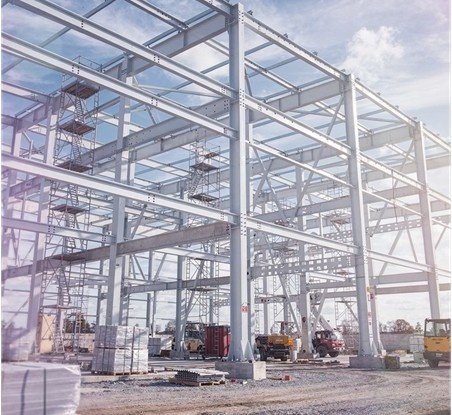
Modern light gauge steel systems routinely achieve clear spans of 40 to 60 feet in warehouse applications, with engineered truss systems extending beyond 100 feet. These capabilities stem from advanced structural engineering principles and optimized member configurations.
Engineers leverage built-up sections, back-to-back assemblies, and composite joist designs to distribute loads efficiently across extended spans. Web stiffeners and strategic bracing systems prevent local buckling while maintaining the lightweight characteristics that make LGS economically attractive.
For warehouse projects requiring column-free interior spaces, LGS roof and floor systems provide the structural performance needed without the material costs and erection complexities associated with traditional structural steel.
Key Advantages for Industrial Warehouse Projects
Accelerated Construction Timelines
Prefabricated components arrive ready for assembly, reducing on-site labor by 30–40% compared to conventional methods. Typical warehouse frames can be erected in weeks rather than months.
Reduced Foundation Requirements
LGS systems weigh 60–70% less than comparable concrete or masonry construction, significantly lowering foundation costs and enabling construction on challenging soil conditions.
BIM Integration & Precision
Light gauge steel components integrate seamlessly with Building Information Modeling workflows, enabling clash detection, accurate quantity takeoffs, and coordinated shop drawings before fabrication begins.
Sustainability & Recyclability
Steel contains up to 90% recycled content and remains 100% recyclable at end of life. Material waste on LGS projects averages just 2%, compared to 15–20% for wood framing.
Successful implementation of light gauge steel in industrial warehouses requires careful attention to critical structural and performance factors. Addressing these considerations early in the project lifecycle ensures optimal structural performance and cost efficiency.
Proper evaluation of dead loads, live loads, equipment loads, and environmental forces ensures accurate member sizing. Selecting appropriate stud depths, gauges, and spacing is critical for achieving both structural integrity and material efficiency in large-span warehouse environments.
Continuous load transfer from roof to foundation must be achieved through properly designed connections and lateral force-resisting systems. Bracing strategies, shear walls, and diaphragm action must be coordinated to resist wind and seismic forces typical in industrial facilities.
Thermal bridging mitigation through insulated sheathing and strategic detailing maintains energy efficiency in climate-controlled facilities. Appropriate gypsum board assemblies and spray-applied fireproofing systems ensure required fire-resistance ratings for industrial occupancies while preserving long-term durability.
Design Considerations for Warehouse Applications
Load Analysis & Member Selection
Load Path Engineering & Lateral Design
Thermal Performance & Fire Resistance
At Consac, our integrated architectural, engineering, and digital solutions approach ensures light gauge steel warehouse projects are optimized from concept through construction. Our multidisciplinary teams combine structural analysis, advanced detailing, and BIM coordination to deliver efficient, constructible designs.
We provide comprehensive services including load calculations, connection design, shop drawing production, and 3D modeling that enables contractors to visualize assemblies before fabrication. Our CAD and BIM specialists work directly with fabricators and erectors to resolve conflicts early, reducing costly field modifications.
This collaborative methodology has helped developers, general contractors, and engineering consultants across the United States execute warehouse projects that meet aggressive schedules while maintaining structural integrity and budget constraints.
Consac's Approach to LGS Warehouse Engineering
Our Core Capabilities
Building the Future of Industrial Construction
Light gauge steel framing represents a proven, cost-effective solution for industrial warehouse projects requiring large-span capabilities. As supply chain demands continue driving warehouse development, LGS systems offer the speed, precision, and structural performance needed to meet market demands.
For project managers, engineers, and developers evaluating framing systems for their next warehouse project, light gauge steel delivers measurable advantages in construction speed, material efficiency, and long-term performance. When paired with advanced engineering services and digital coordination, LGS becomes a powerful tool for executing successful industrial projects.
The combination of engineered precision, rapid erection, and design flexibility makes light gauge steel an increasingly strategic choice for the modern warehouse construction landscape.
What's Your Reaction?