Seismic Performance of Light Gauge Steel Buildings
Understanding how structures respond to earthquakes is critical for safe, resilient design. Light gauge steel (LGS) buildings offer unique advantages in seismic zones, combining flexibility, strength, and efficient construction methods that can save lives and reduce damage.
Why Seismic Performance Matters in Modern Construction
|
Earthquakes pose significant risks to buildings, infrastructure, and human safety across many regions of the United States and worldwide. The performance of a structure during seismic events depends on material properties, structural system design, connection details, and compliance with building codes. Light gauge steel framing has emerged as a viable alternative to traditional construction methods in seismic regions. Engineers, architects, and builders are increasingly recognizing its potential to deliver both safety and cost-effectiveness in earthquake-prone areas |
|
Key Advantages of Light Gauge Steel in Seismic Zones
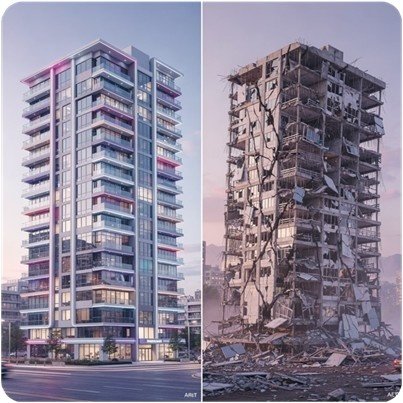
Designed for resilience, light gauge steel provides critical performance benefits that enhance structural safety and accelerate construction in earthquake-prone regions.
Lightweight Construction
LGS systems significantly reduce overall building mass, which directly lowers seismic forces. Less mass means less inertia during ground motion, reducing stress on foundations and structural members.
Ductility & Flexibility
Steel's inherent ductility allows structures to absorb and dissipate seismic energy through controlled deformation. This flexibility prevents catastrophic failure and maintains structural integrity during earthquakes.
Rapid Assembly
Prefabricated LGS components enable faster construction timelines with precision manufacturing. This reduces on-site labor, minimizes errors, and accelerates project delivery in high-demand seismic regions.
Critical Components of Seismic-Resistant LGS Systems
Structural Sheathing
Oriented strand board (OSB) or steel sheathing panels attached to LGS framing create composite action that dramatically increases lateral stiffness and strength. Proper fastener scheduling and edge nailing patterns are essential for performance.
Hold-Down Anchors
These critical connections resist uplift and overturning forces at the base of shear walls. Design must account for tension loads, foundation capacity, and potential movement during seismic events.
Strap Bracing
Diagonal steel straps provide efficient lateral resistance with minimal material. X-bracing or K-bracing configurations work in tension to stabilize frames against horizontal forces.
Track-to-Foundation Connections
Anchor bolts or powder-actuated fasteners secure the base track to concrete foundations. Spacing and capacity must transfer calculated shear forces safely into the foundation system.
Testing, Analysis, and Code Compliance
Validating seismic performance requires rigorous testing and analysis methods. Shake table testing, cyclic loading tests, and finite element analysis help engineers predict real-world behavior and verify design assumptions.
Building codes such as the International Building Code (IBC), ASCE 7 for minimum design loads, and AISI S240 for cold-formed steel framing provide prescriptive requirements and performance criteria. Companies like Consac integrate these standards into their engineering workflows, ensuring that structural designs meet or exceed regulatory requirements while optimizing material usage and constructability.
Code Review
Verify compliance with IBC, ASCE 7, and AISI standards for seismic design categories and site-specific parameters.
Structural Analysis
Perform response spectrum analysis, modal analysis, or nonlinear time-history analysis using validated software tools.
Physical Testing
Conduct full-scale or component testing to validate analytical predictions and demonstrate adequate performance margins
Practical Considerations for Project Teams
Successful seismic performance depends not only on design, but on execution, coordination, and the smart use of digital technologies throughout the project lifecycle.
Installation Quality Control
Even the best designs fail without proper installation. Train crews on fastener types, spacing requirements, and sequencing. Implement inspection protocols to catch errors before they become structural vulnerabilities.
Coordination Across Disciplines
Seismic design affects architectural layouts, MEP routing, and foundation systems. Early coordination between structural engineers, architects, and contractors prevents conflicts and ensures constructability.
Leveraging BIM and Digital Tools
Building Information Modeling streamlines coordination, clash detection, and documentation. Digital workflows improve accuracy, reduce rework, and provide clear communication throughout the project lifecycle.
Building Safer, Smarter Structures
Light gauge steel buildings offer proven seismic performance when designed, detailed, and constructed according to established engineering principles and building codes. Their combination of strength, ductility, and lightweight construction makes them an excellent choice for earthquake-prone regions.
For project managers, engineers, and construction professionals, understanding these principles translates to safer buildings, reduced risk, and more resilient communities. The key is rigorous engineering, quality control, and collaboration across all project stakeholders.
Whether you're planning a new development, evaluating structural systems, or seeking to improve seismic resilience, light gauge steel framing deserves serious consideration as a practical, cost-effective solution for modern construction challenges
What's Your Reaction?